Call: +918448223338 08045478320
 Send Inquiry
Description:
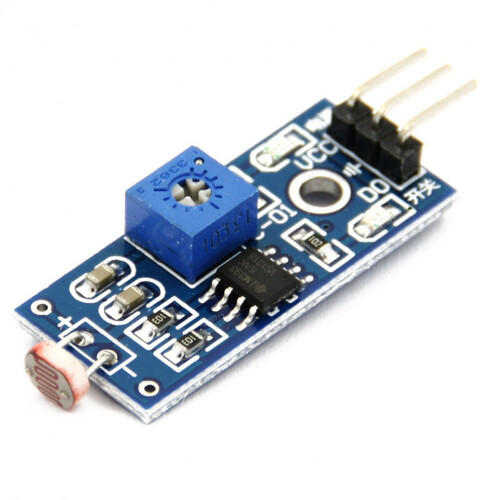
Photosensitive resistance module to the ambient light is the most sensitive generally used to detect the surrounding environment of the brightness of the light, trigger SCM or relay module, etc. A module in ambient light brightness cannot reach the set threshold, DO end output high level, when an external environment light brightness than setting a threshold value, DO end output low level.DO output port can be directly connected with the single-chip microcomputer, through the single-chip microcomputer to detect high and low levels, thus to the testing environment, light intensity change DO output end can directly drive the relay module, which can form a light-operated switch.
Specification:
Operating Voltage: 3.3V to 5V DC
Operating Current: 15mA
Features:
Output Digital - 0V to 5V, Adjustable trigger level from preset
Output Analog - 0V to 5V based on light falling on the LDR
LM393 based design.
It can detect ambient brightness and light intensity.
Adjustable sensitivity (via blue digital potentiometer adjustment).
LEDs indicating output and power.
Pin Description:
VCC: 3.3V to 5V DC
GND: Ground
DO: Digital Output

Price:
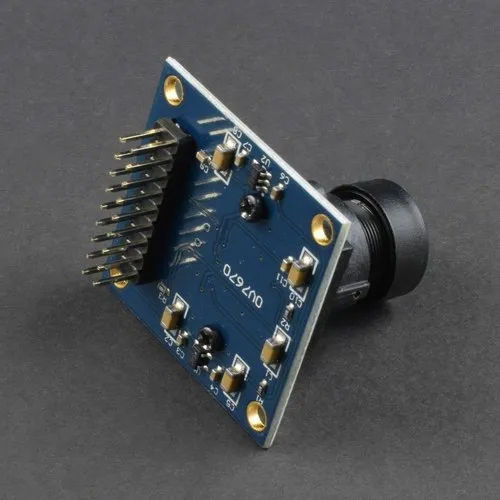
Price 115 INR / Piece
Minimum Order Quantity : 100 Pieces
Material : pcb Fiber
Voltage : 1.3 Volt (v)
Sensitivity : Very high (suitable for lowlight)
Usage : Industrial
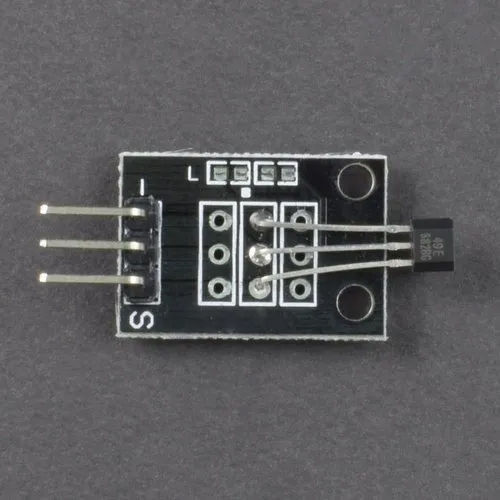
Price 90 INR / Piece
Minimum Order Quantity : 1 Piece
Material : pcb Fiber
Voltage : 2.35.3 Volt (v)
Sensitivity : 1.41.6 mV/Gauss
Usage : Industrial

Price 340 INR / Piece
Minimum Order Quantity : 1 Piece
Material : Pvc
Voltage : 4.4 5.5 Volt (v)
Sensitivity : 0.1 mg/m
Usage : Industrial

Price 29 INR / Piece
Minimum Order Quantity : 1 Piece
Material : Pvc
Voltage : 4.520 V DC Volt (v)
Sensitivity : Resistive
Usage : Industrial
GST : 07AAGCR7293D1Z6


 Send Inquiry


 Send Inquiry


 English
 Spanish
 French
 German
 Italian
 Chinese (Simplified)
 Japanese
 Korean
 Arabic
 Portuguese