433 MHz Transmitter And Receiver About
Description :
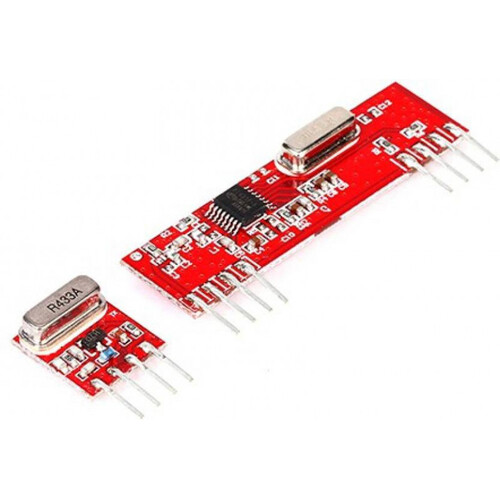
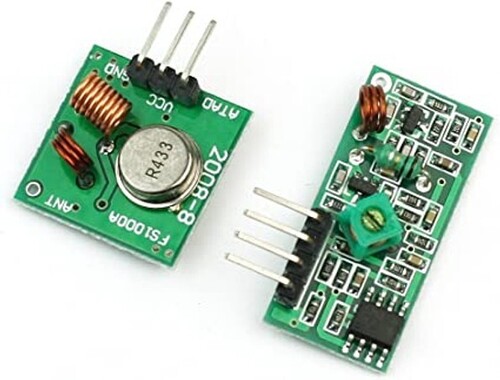
This RF module comprises an RF Transmitter and an RF Receiver. The transmitter/receiver (Tx/Rx) pair operates at a frequency of 434 MHz. An RF transmitter receives serial data and transmits it wirelessly through RF through its antenna connected at pin4. The transmission occurs at the rate of 1Kbps - 10Kbps. The transmitted data is received by an RF receiver operating at the same frequency as that of the transmitter. In many projects, we use RF modules for transmitting and receive the data because it has a high volume of applications than IR. RF signals travel in the transmitter and receiver even when there is an obstruction. It operates at a specific frequency of 433MHz. RF transmitter receives serial data and transmits to the receiver through an antenna which is connected to the 4th pin of the transmitter. When logic 0 applied to transmitter then there is no power supply in the transmitter. When logic 1 is applied to transmitter then the transmitter is ON and there is a high power supply in the range of 4.5mA with the 3V voltage supply.
Specification:
RF Transmitter:
Frequency Range: 433.92 MHz
Supply Voltage: 3V - 12V
Output Power : 4 - 12 dBm
Standard Operating Voltage: 5V
RF Receiver:
Receiver Frequency: 433.92 MHz
Typical Sensitivity : 105 dBm
Supply Voltage: 3V - 12V
Supply Current: 3.5 mA
Standard Operating Voltage: 5V
Applications
Remote Controls
Automation System
Wireless Security System
Sensor Reporting
Car Security System
Remote Keyless Entry
Reliable Wireless CommunicationOperating at 433.92 MHz, this transmitter and receiver pairing ensures stable and interference-resistant signal transmission. Its compact build makes it suitable for varied applications like remote controls, wireless alarms, and data transmission, providing flexibility without the need for complex wiring.
User-Friendly Design and InstallationWith its manageable size and clear color-coding (black and red), this module is simple to integrate into existing electrical setups. It supports both AC and DC inputs, making it adaptable to different environments and requirements. Installation is straightforward, and external power supply design supports ease of maintenance.
FAQ's of 433 MHz Transmitter And Receiver:
Q: How do I install the 433 MHz Transmitter and Receiver?
A: Installation involves connecting the module to an external power supply within the 5V-12V DC range. After connecting the antennas, integrate it into your remote control circuit or wireless application. Ensure that the module is located indoors, as it is not waterproof.
Q: What applications are suitable for this 433 MHz module?
A: This transmitter and receiver are ideal for remote controls, wireless door alarms, smart home automation, and wireless data transmission over medium distances. Its stable frequency ensures reliable performance across such uses.
Q: When should I use an external power supply for this module?
A: You should always use an external power supply between 5V and 12V DC, as the device is designed to run on external power for optimal performance and safety. Internal batteries are not recommended or supported.
Q: Where can I purchase this module?
A: This 433 MHz Transmitter and Receiver is distributed, exported, imported, manufactured, supplied, traded, and wholesaled by leading providers based in Taiwan. Check with reputable electronics distributors or suppliers for availability.
Q: What is the process for pairing the transmitter and receiver?
A: To pair the devices, ensure both units operate on the 433.92 MHz frequency and are correctly wired to their respective circuits. Power both devices, and press the pairing button or follow your system's specific programming instructions for a synchronized connection.
Q: How can I benefit from using this wireless module?
A: Using this module removes the need for complex wiring, reducing setup time and cost. It enables reliable, interference-resistant wireless communication, making it ideal for flexible, modern electronic projects.
Q: Is this product suitable for outdoor use?
A: No, this module does not carry a waterproof (IP) rating and should only be used in dry, indoor environments to avoid damage and ensure safe operation.
 Send Inquiry



 Send Inquiry


 Send Inquiry


 English
 Spanish
 French
 German
 Italian
 Chinese (Simplified)
 Japanese
 Korean
 Arabic
 Portuguese